
Located an hour’s drive north of Rio de Janeiro the city of Petropolis turns out to be not – as its name initially suggests – some sweaty oil town, but a quite lovely-looking municipality surrounded by wooded hills with nineteenth century European-style architecture. It was here in the early 1940s that Austrian chronicler of fin de siecle Vienna Stefan Zweig and his wife Lotte fetched up having fled the Nazis. A pleasant setting to sit out the war in an allied country; and yet in February 1942 out of despair the couple would take their lives.
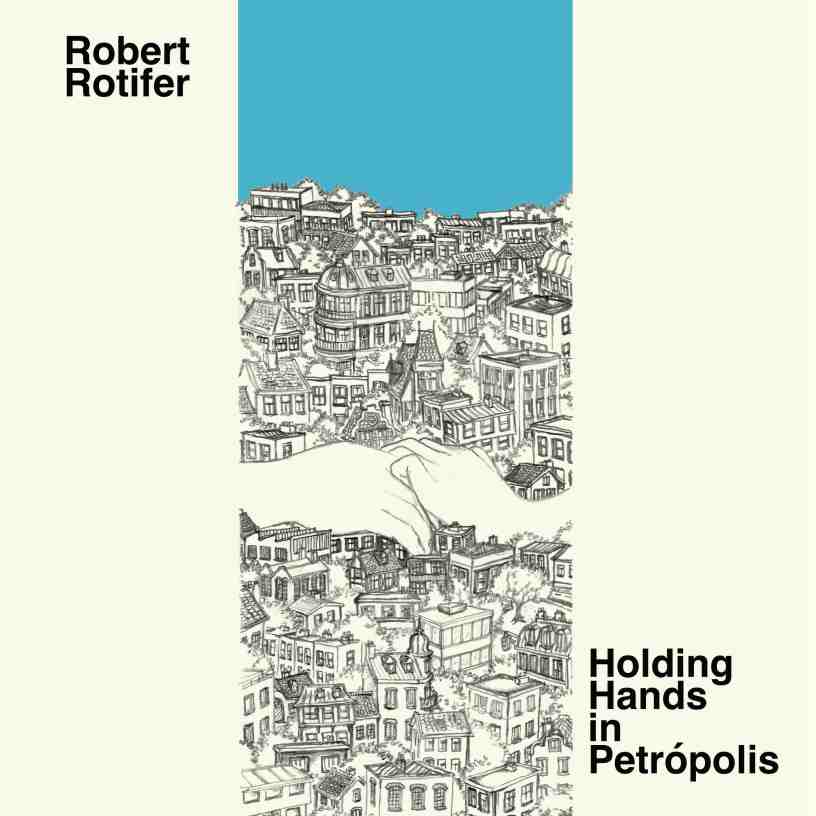
There’s a notable photo of them, in death, still holding hands, and it’s this Robert Rotifer refers to in the title of his new record. An Anglophile Austrian long-based in the UK, and a current affairs commentator in the German-language press, he’s well-placed to have both observed and experienced the last decade’s unending waves of political derangement. Aware too, from his country’s history, of where that derangement can ultimately lead.
He’s already addressed the specific circumstance of Brexit in 2018’s They Don’t Love You Back but this collection faces more existential matters; a man broadly of the left now past fifty contemplating his decades of adulthood and the life he’s seen and participated in. Plainly he’s not happy with the current polity but if there’ve been moments of Zweig-like despair they’ve not been succumbed to but channeled into a set of eight songs full of bright intelligence, clever, nuanced, and massively listenable, exploring both the regrets and the shorings of his generation.
A cohort of sympathetic English and Austrian musicians have been marshalled for Holding Hands in Petropolis. For the last decade Robert has been a crucial part of the Papernut Cambridge/Gare du Nord collective, so it’s no surprise to find Ian Button and Rob Halcrow here along with recent collaborators Amelia Fletcher, Helen McCookerybook, and Fay Hallam. Further contributions come from Paul Pfleger, Stootsie, and Aram Zarakan. There’s a sense they’re providing settings and playing around the songs so the voice predominates; certainly there’s an urgent clarity to the half-spoken, half-sung words, and those lyrics never give up needing to be heard; but the artifice shouldn’t be underestimated.
The album’s title comes from the opening track, though ‘He’s Not Ill’ refers to the more recent passing of director Jean-Luc Godard who died with assistance in a Swiss clinic “not ill, just exhausted”. Beginning with a near-imperceptible flicker of percussion it expands across eight minutes of reflection, with pulses, hints of guitar, moments of dream and then little bursts of vigour; a short interlude reaching towards Bacharach-like melodic pop before lapsing back languid. The lyric wandering in and out of fatigue before giving way to an extended instrumental outro
‘That Was The Time’ and ‘Chewing On The Bones Of The Sacred Cow’ are both reflections on a personal past; respectively political and cultural. The former charts, to a continental swing, much enhanced by Fay Hallam’s keys and Ernst Molden’s harmonica, a progress through “our time” noting 80s agitation, the 90s Third Way, and then what in the 00s and 10s? Really just the sense that ‘we’ somehow lost it. The latter plays out, after a brief Byrdsian chime, as a music nerds conversation, somewhat akin to Kevin Rowland on Dexys’ third; the box set has arrived and, as so often in spite of plenteous bounty, more turns out to be less. The lyric and the delivery however is a tour de force, and quite probably a metaphor for something else entirely.
‘Red, Yellow, Orange & Green’ is a beautiful love-song in autumn on which Amelia Fletcher shares lead vocals and Ian Buttons summons harpsichord sound from his mellotron; it’s almost folk and the place where Robert starts to remind us of Jake Thackray. ‘Change Is In The Air’ provides astute if initially accidental self-examination; “self-hate, baby, is narcissism too” quite the brutalist of lyrics. While ‘Man In Sandwich Board’ tells a pointed yet whimsical tale of returning to 1984 to become an unheeded Cassandra.
Earlier ‘Those Dreams Again’, in the way dreams do, had wandered around itself, slipping and drifting with lovely backing vocals and Stootsie’s baritone guitar, noodling towards what might almost be a fragment of Grateful Dead improv. It seems to presage the album closer ‘Slipped In The Rain’- equally an analogue to ‘He’s Not Ill’ – which raises the recounting of a minor public mishap to the level of existential crisis with the sense of a life flitting out of control. The backing voices drifting in and out of hearing come from the other songs on the album and thus it almost seems the last moments of a dying man falling out of life… and thus back to Brazil.
Yet while speaking to the melancholy of the engaged and easily engendering reverie Holding Hands in Petropolis, for all its beginnings in exhaustion proves ceaselessly awake, endlessly defiant, and delivers a gorgeous listening experience.
Holding Hands in Petropolis is available now from Gare du Nord. London album launch at The Betsey Trotwood 11th Oct – details and ticket link
 Bucketfull Of Brains