

Back in my regular writing days I was always happy to see a fresh Cherry Red box set. There was always something interesting popping up; from career retrospectives – The Times, Mighty Baby, The Action – to genre sets – psychedelic sounds, folk-pop, 70s country rock – to label collections – Clarion, Alshire. Sometimes a mite eccentric; there’d be curious lacunae, generally down to contractual issues, and bits of making-do; but invariably fascinating and throwing light through informative annotations.
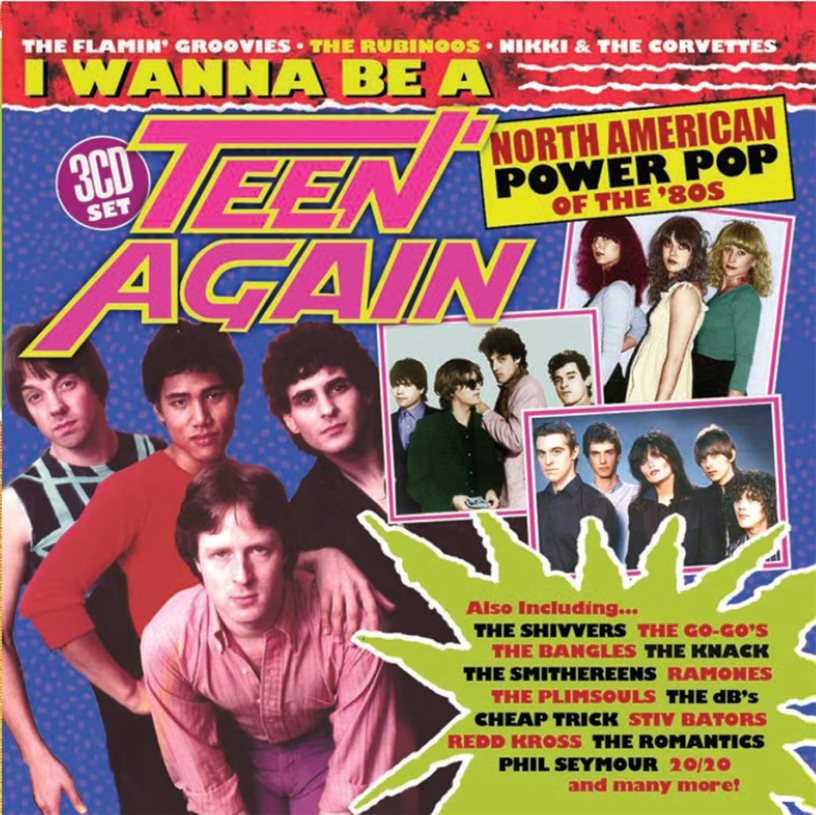
The quality and quantity is likely undiminished but looking back over 2025 there were three that really took my eye (and ears), and that I regularly played over the summer and autumn. The first and best has to be I Wanna Be A Teen Again: North American Power Pop Of The ‘80s; it’s perhaps the best reissue of the year or maybe joint-first with The Dream Syndicate’s Medicine Show box.
Power Pop is the genre that existed before it had a name, and immediately a prompter of numerous overviews; from Greg Shaw in Bomp #18 in 1978 to the recent Big Stir #6 a couple of years back. Born on the cusp of the 70s, combining melody, energy, and harmony, teenage joy and teenage angst, it took cues from early Who and Beatles’ sides, initially breaking cover when The Raspberries and Todd Rundgren scored notable US hits.
Big Star, Dwight Twilley, and a growing unsung cohort tended the flame until Punk’s blossoming revived the primacy of songs and singles, and Power Pop rode shotgun to New Wave bursting into full life alongside it. This set’s predecessor Looking For The Magic: American Power Pop In The Seventies was obliged to stretch its definition somewhat and include a number of (seriously excellent) cuts that had little business being there. Come the 80s however compiler Dave Laing is working with a veritable embarrassment of riches and every selection is right on the money.
The decade split does give a slight impression of coming in late; a problem avoided by the earlier – and equally essential – Come On Let’s Go! Power Pop Gems From The 70s & 80s Big Beat’s 2019 single disc set (a number of bands, but no titles, are replicated here). Laing’s critical introduction doesn’t duck this, prior to elucidating the genesis and evolution of the tendency, and presents an indisputable formulation – ‘hooks, harmonies, and high-energy’.
Throughout the sequence he trusts to his instincts, and keeps to it; and while there’s a definite progression discernible across seventy-eight tracks running from Stiv Bators to Velvet Crush, fundamentally it works as a sublime set of pop songs; and incidentally a fascinating introduction to a whole raft of personalities who’ll play major roles in independent music across the following four decades.
Just a few examples, or possibly this weeks personal highlights. Gary Valentine’s post-Blondie LA band The Know’s demo of ‘(I’m Always Touched By Your) Presence Dear’ with its Tom Verlaine patina. NRBQ’s glorious ‘You Can’t Hide’; their 1980 rerecording of a song they’d originally come up with in 1969. Their earlier ‘I Want You Bad’ is also here in the version by The Long Ryders who might well have learnt it from The Flamin’ Groovies, present with ‘So Much In Love’ a 1981 b-side from Gold Star Sessions.
The classic Memphis Big Star-ish sound comes from Tommy Hoehn’s ‘Get Away’; a 1981 take on the then-unknown Chris Bell song. There’s Grammy-winning Tommy Marolda providing the set’s title with the increasingly plaintive ‘(I Wanna Be A) Teen Again’ credited to The Toms on which he plays everything.
North Carolina’s Chris Stamey arrived in New York in the mid-70s, witnessed everything, played a role at Ork who released his timeless ‘The Summer Sun’, and then formed The dBs with old mates Peter Holsapple, Will Rigby, Gene Holder; that classic line-up cut the equally immortal ‘Love Is For Lovers’. Native New Yorkers The Ramones entered the 80s with a pair of albums more pop than punk; Pleasant Dreams produced by Graham Gouldman, and Subterranean Jungle which provides ‘My-My Kind Of A Girl’.
Katrina & The Waves would in 1997 win the Eurovision Song Contest for the UK, and Soft Boy Kimberley Rew was a central member but Katrina was a Yank so that allows 1985s ‘Do You Want Crying’ in. Likewise with Chris ‘Klondike’ Masuak; the Radio Birdman/Hitmen stalwart was born a Canuck thus ‘How Could He Resist’.
The much-missed Tommy Keene’s 1986 Geffen single ‘Places That Are Gone’ is a highlight of any week especially given its little touch of St. Paul. Similarly Flying Color’s ‘Dear Friend’; the wonderful short-lived West Coast band‘ featuring Dale Duncan and Hector Penalosa, and latterly Chris von Sneidern who’d partially later regroup as Map Of Wyoming.
Lastly The Decoys, New York folk-rockers who made but one single. However it was George Usher’s ‘Not The Tremblin’ Kind’; a song of such quality that I’d give any collection a free pass on the grounds alone that it was included. Not that this box needs any such help (just buy it, you won’t be disappointed).

A first glance at When Will They Ever Learn? A Story Of U.S. Folk Music 1963-1969 might elicit a slight yawn and the ‘who needs’ question but stay one moment, note well that indefinite article, and the identity of the compiler, eminent PR/writer Mick Houghton. A closer look at the track list reveals this to be an inventive revisiting avoiding the obvious and over-anthologised, with familiar songs found in less familiar versions. Furthermore over the four discs it follows American folk where it goes across the decade rather than sticking to a specific location, narrative, or even genre.
There are the inevitable availability issues, specifically of Vanguard performers, meaning no Baez, Richard Farina, or Ian & Sylvia, and nothing from Eric Andersen until his move to Reprise, but it barely shows. Andersen’s best songs do appear in other versions; The Dillards ‘Close The Door Lightly’ and Anne Murray’s ‘Thirsty Boots’.
The set’s title derives from Pete Seeger’s ‘Where Have All The Flowers Gone’ and The Kingston Trio’s version kicks off the sequence. Appropriate because half a decade before the trio’s ‘Tom Dooley’ had arguably launched the folk revival in storming to the top of the U.S. charts. This first is predominantly the pioneers; the names turning up in the early pages of the Greenwich Village retrospectives – Tom Paley, Paul Clayton, Bob Gibson, The Limeliters – a little older than the Dylans and Dobsons they prepared the ground and provided the example. Though there’s also The Journeymen – John Phillips and Scott McKenzie – with ‘All The Pretty Little Horses – who’ll we meet down the road on another coast, The Simon Sisters – Lucy and Carly, and Fred Neil and Vince Martin doing ‘Morning Dew’.
If Disc 1 is the before, Disc 2 is already straining towards the after. It begins with Judy Collins singing Phillips’ ‘Me And My Uncle’, and then Bonnie Dobson singing her housemate Judy Roderick’s ‘Country Girl Blues’. But Jackie De Shannon’s ‘When You Walk In The Room’ follows and The Searchers would soon take that song and provide the template for The Byrds. Barry McGuire’s ‘Eve Of Destruction’ for a while tested the protest song to breaking point; it sits adjacent to its composer P.F. Sloan’s ‘Take Me For What I’m Worth’. There’s a nice take on ‘Green Rocky Road’ from Kathy & Carol – Joan Baez times two according to producer Paul Rothchild, and ‘Grand Hotel’ from younger Dylan acolyte David Blue who never quite escaped the shadows and died way too soon.
Disc 3 (Leaving The Folk Music Behind) takes its title from The Mamas And The Papas ‘Creeque Alley’, another John Phillips song, soon followed by Gene Clark’s baroque take on Ian Tyson’s ‘The French Girl’. The bedfellows are now getting distinctly odder as anything starts to go; Nico’s ‘I’ll Keep It With Mine’ immediately precedes The Dead’s ‘Cold Rain And Snow, and they’re followed fast by The Youngbloods hippie anthem ‘Get Together’, The Leaves version of Buffy Sainte-Marie’s ‘Codeine’, and Kaleidoscope’s ‘Banjo’.
As the 70s beckoned the folk impulse had fully diversified encompassing the outlaw wing of country music – Jerry Jeff Walker and Townes Van Zandt – ‘Mr Bojangles’ and ‘Tecumseh Valley’ along with singer-songwriters like Tom Rush (‘Tin Angel’) and Steve Noonan (‘Shadow Dream Song’). There was also space for free radicals like H.P. Lovecraft, The Insect Trust, and Pearls Before Swine; with the penultimate song being Judy Henske & Jerry Yester’s ‘Three Ravens’ from the indefinable Farewell Aldebaran.

The first thing to say about A Curious Mind is it probably isn’t entry-level Joe Meek. The title reflects his various obsessions, and the three discs are a bit of a hodge-podge taking in space exploration, horror, death, the old West or Hollywood’s view thereof, and I Hear A New World – the famed outer space music fantasy. Of the eighty two tracks fifty-seven are previously unheard as they’re newly extracted from the Tea Chest Tapes, but given Meek’s propensity to recycle there’s a fair amount of familiarity if you already know his stuff.
That stated there’s a lot to enjoy and appreciate here and the first two of the three CDs do work as sequences. Disc 1 is Beyond The Stars, and here we have all the famous space songs beginning with a stereo take of ‘I Hear A New World’, an alternative edit of ‘Telstar’, Geoff Goddard’s ‘Sky Men’ and Glenda Collins’ ‘It’s Hard To Believe It’ with changed lyrics. Following this big four there come the many and various attempts by The Tornados to replicate ‘Telstar’s success; ‘Globetrotter’, ‘Robot’, and ‘Life On Venus’ – a U.S. 7” subtitled ‘Telstar II’ for obvious reasons.
Glenda Collins reappears with ‘Magic Star’ – ‘Telstar’ with lyrics – in a recording from late 1966 or even early 1967 with The Riot Squad. ‘Lost Planet’ and ‘March Of The Spacemen’ from The Thunderbolts whose line-up features Charles and Kingsley Ward later of Rockfield Studios. Nobody knows who The Rhythmics were but they covered ‘Telstar’ and other Tornados tunes. Plus there’s Joe with various ‘Spacescapes’ and a short vocal try-out of ‘Have You Ever Tried Living On The Moon’ which apparently went no further.
Beyond The Grave/Out West indicates the split nature of the second disc. The first fourteen songs all fall under horror and prominently involve Screaming Lord Sutch; alongside ‘Jack The Ripper’ and ‘Monster In Black Tights’ is a ‘Screaming Session’ with Joe and his Lordship getting down some effects. The Moontrekkers provide instrumentals ‘Nightfall’ and ‘Return Of The Vampire’; they did have a singer but Meek was unimpressed and sent Rod Stewart packing. Another mystery is the identity of Doctor Dark, voice of the immortal ‘Put Me Back To Rot’.
A trio of death songs comprise Mike Berry’s ‘Tribute To Buddy Holly’, Heinz’s ‘Tribute To Eddie’, and John Leyton’s ‘Johnny Remember Me’. The themes persists into the western songs; Houston Wells & The Marksmen (the frontman actually Andy Smith from Northumberland), The Ferridays, and Pamela Blue each encompass both. Blue’s ‘My Friend Bobby’ – a Geoff Goddard song – is pretty impressive. Burr Bailey’s ‘Chawahawki’, maudlin, implausible – the singer’s dog is shot at Wounded Knee – is not. In the middle of all this comes Harold Smart’s ’Manhunt’ an energetic organ-based instrumental.
The final disc comprises alternative stereo takes from I Hear A New World. As an insight into Meek’s working practice it’s fascinating, as a listening experience it’s a mite trying. If you want to get into I Hear A New World look for the él Records box set from 2019 that featured both the 1991 RPM Restoration and the Original Unreleased Album of 1960.
 Bucketfull Of Brains